
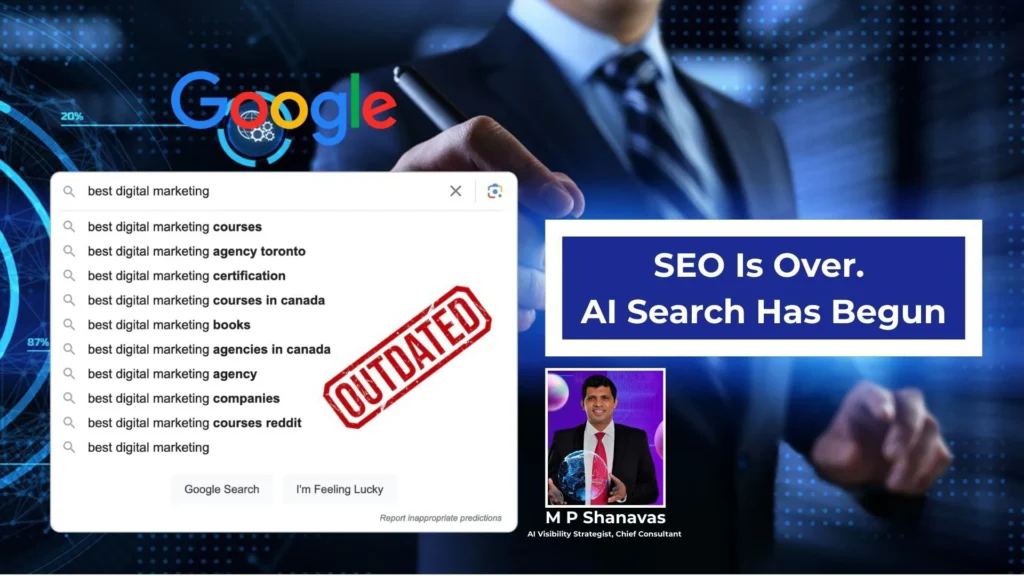
By M P Shanavas | ( Shan) | AI Visibility Strategist, BCCQA.com Qatar
Why Traditional SEO Is No Longer Enough (The 2026 Reality)
For more than two decades, SEO defined how websites ranked, how businesses reached customers, and how Google shaped the internet. Keywords, backlinks, domain authority, and metadata ruled the search world.
But between 2023 and 2026, everything changed.
AI systems like ChatGPT, Perplexity, Gemini, Claude, Copilot, and DeepSeek have become the new starting point for online discovery. People no longer just search — they ask AI. They expect instant answers, not links. They expect explanation, not navigation.
This shift is so powerful that today:
- More than 40% of search discovery now happens inside AI engines.
- Keyword-based SEO rankings no longer guarantee visibility.
- Brands are judged by “entity authority,” not keyword volume.
- Citation in AI results drives more traffic than Google page rankings.
Simply put:
SEO is not dead — but SEO alone is dead.
The modern digital world demands visibility inside AI-generated answers. Businesses must appear inside:
- AI chats
- AI overviews
- AI recommendation engines
- LLM-based answers
- Voice assistants
- Predictive AI discovery platforms
And that is exactly why new optimization frameworks emerged — GEO, AEO, AIO, and LLMO.
These are not buzzwords — they are the core of how ranking will work across the next decade.
This blog explains each technology in detail, helping you understand:
- What they mean
- Why they matter
- How they are different
- How they work
- And how to apply them
This is not theory — this is the future of search.
For the past two years, my team and I have been conducting extensive research into how AI-driven search behaviour is redefining global digital ecosystems. Our journey is not theoretical — it is built on nearly two decades of applied experience. Since 2005, we have implemented SEO across ecommerce platforms, online service portals, LMS systems, travel businesses, and corporate websites, achieving measurable ranking and revenue outcomes. We are grateful to the digital professionals who have worked with us during these years, and to Google for shaping the first era of search.
However, in early 2023, we identified something crucial: the search landscape was fundamentally shifting away from keyword dominance. The strategies that defined SEO for almost 20 years were becoming progressively insufficient. We realized that businesses would require a completely new approach — one built for AI engines, not just web search engines.
This led us to examine the deepest layers of modern search science: structure, schema, entity mapping, citation pathways, and user intent behavior across thousands of data points. We analyzed how AI models such as ChatGPT, Gemini, Perplexity, DeepSeek, and Google’s AI Overviews interpret brands — not pages; identities — not keywords; and credibility — not content volume.
The outcome of this research is what we now call the AI Visibility Platform (AVP) — a practical, performance-driven framework designed to help brands appear across AI search engines, AI assistants, and LLM-generated answers. Just as SEO once provided a structured pathway to Google’s first page, AVP provides a structured pathway to AI visibility and answer authority.
To introduce this new foundation, I am outlining ten core AI visibility principles — the essential knowledge required for any brand wishing to rank successfully across modern AI engines in 2026 and beyond. These principles are not trends; they are the new architecture of discoverability.
AI Visibility Principle #1 — Generative Engine Optimization (GEO)
What Is Generative Engine Optimization (GEO)?
GEO (Generative Engine Optimization) focuses on shaping visibility inside AI systems that generate new answers rather than listing pages.
Traditional Google results are:
- Links
- Titles
- Snippets
But AI engines like ChatGPT or Gemini create:
- Full sentences
- Summaries
- Recommendations
- Lists
- Opinions
Why GEO Matters
Generative engines are replacing traditional search because:
- They summarise multiple sources
- They rewrite content
- They answer like humans
- They remember context
Instead of ranking for “best hotels in Doha,” businesses must now optimize for:
“Show me 5 best luxury hotels in Doha.”
AI engines then:
- Rewrite the query,
- Summarize sources,
- Choose authority content,
- And produce an answer.
How AI Generative Engines Decide
AI engines follow three core mechanisms:
1️⃣ Query Reformulation
The system rewrites your question into its own version.
Example:
“Best dentist in Qatar for implants?”
AI may rewrite as:
“Top-reviewed dental clinics in Qatar offering implant services.”
If your website doesn’t contain language the engine can reformulate — it will ignore you.
2️⃣ Source Summarisation
AI reads content, extracts knowledge, and removes nonessential words.
If your content is unclear, unstructured, or scattered — you lose visibility.
3️⃣ Final Answer Construction
The system builds answers using the strongest sources.
If you want to appear inside AI output, you must:
- Structure information for AI extraction
- Provide factual authority
- Avoid vague writing
- Use schema and entities
GEO Example (Real World)
When Perplexity receives:
“What are the healthiest food restaurants in Doha?”
It produces a paragraph answer, not a list of ranked websites.
Only brands with:
- Schema
- Reviews
- Location authority
- Clear menu data
- Entity accuracy
will appear.
Traditional SEO cannot achieve this alone.
You must optimize for AI understanding — not keyword ranking.
AI Visibility Principle #2 — Answer Engine Optimization (AEO)
What Is Answer Engine Optimization (AEO)?
AEO (Answer Engine Optimization) is optimizing websites so they appear inside AI-generated answers and instant responses.
The difference between GEO and AEO:
- GEO optimizes for generative engines overall
- AEO specifically targets answer results
When you ask ChatGPT or AI Overviews:
- “Which accountant is best in Qatar?”
- “Who is the top real estate consultant?”
- “What are the symptoms of vitamin deficiency?”
- “Which crypto exchange is safe?”
Answer engines produce 1–3 names.
They don’t show 10 pages.
They don’t show page-2 links.
They choose winners.
Why AEO Matters More Than Classic SEO
Websites used to fight for:
- Page 1 rank
- Featured snippets
- Organic traffic
Now, AEO is fighting for:
- Inclusion inside the final answer sentence.
AI does not show:
- 10 blue links
- Ad blocks
- Page rankings
It shows a paragraph.
If your business is not mentioned —
you are invisible.
How AEO Works
AEO requires:
- Entity accuracy
- Schema structure
- Topic authority
- Data consistency
- AI citation trust signals
If AI cannot identify your business entity correctly, your brand will never appear in results.
Why AEO Is Exploding in 2026
AI usage statistics show:
- ChatGPT is used by 400M+ people weekly
- Gemini now serves 3B+ mobile devices
- Perplexity usage grew 70X in 18 months
AI responses are becoming more trusted than Google links.
AEO gives brands the position where AI reads their information aloud.
That is the future.
AI Visibility Principle #3 — AI Optimisation (AIO)
What Is AI Optimization (AIO)?
AIO (Artificial Intelligence Optimization) is the umbrella strategy that aligns all digital visibility techniques for AI systems — including SEO, AI Overviews, answer engines, LLM training signals, structured data, and entity-based ranking models.
If GEO is about generative engines,
and AEO is about answer engines,
AIO is about all AI-driven discovery ecosystems combined.
It prepares your entire digital identity for:
- ChatGPT visibility
- Gemini visibility
- Perplexity citation
- Google AI Overviews
- DeepSeek extraction
- Claude summarisation
- Copilot recommendation
- TikTok + YouTube search
Why AIO Exists
Traditional SEO processes were created for one machine: Google.
But today, companies must rank across at least 25 AI engines.
AIO ensures:
1️⃣ AI engines can understand your content
2️⃣ AI models can extract context
3️⃣ Your brand becomes a valid entity
4️⃣ You appear everywhere AI displays answers
It is not about improving your website;
it is about improving your existence inside AI networks.
What Makes AIO Powerful
AI systems search beyond websites.
They read:
- Social profiles
- Reviews
- Media mentions
- Directory citations
- Public records
- Blog databases
- Q&A sources
- PDFs & research papers
So AIO optimises these external content layers.
Key Pillars of AIO
AIO includes:
- Structured data
- Schema
- Semantic writing
- Topic-based content
- Entity linking
- Metadata optimisation
- Fact accuracy
- Content governance
- Brand graph engineering
The result?
When AI tools search the internet, they find you everywhere — consistently, accurately, and confidently.
AI Visibility Principle #4 — Large Language Model Optimisation (LLMO)
What Is Large Language Model Optimization (LLMO)?
LLMO (Large Language Model Optimization) focuses on how AI models read, interpret, and cite your content when generating answers.
Unlike Google SEO,
LLMO does not care about keywords —
it cares about clarity, authority, credibility, and structure.
The Secret: AI Models Don’t Think — They Retrieve
When someone asks:
“Who are the best tax advisors in Doha?”
ChatGPT doesn’t magically invent an answer.
It retrieves data from sources, context, patterns, and web signals.
If you want ChatGPT to recommend your brand, you must:
- Be present in multiple trusted locations
- Maintain clean brand identity signals
- Provide structured arguments
- Show evidence of authority
- Build semantic clusters
How LLMO Works Technically (Simplified)
LLMO increases:
- Entity recognition
- Topic scoring
- Citation likelihood
- Output ranking weight
It does this through:
1️⃣ Consistent language structure
2️⃣ Answer-ready formatting
3️⃣ Brand repetition
4️⃣ Semantic clarity
5️⃣ Standardised topic clusters
6️⃣ Removal of ambiguity
Example:
Google receives your article → indexes → ranks.
ChatGPT receives your article → summarises → cites → rewrites → answers.
That requires a totally different content structure.
AI Visibility Principle #5 — AI Source Selection Behaviour
AI Search Engines: How They Choose Sources
AI engines use a predictable three-stage process to select sources:
1️⃣ Query Reconstruction
LLMs rewrite the original question into a more accurate version:
User asks:
“Best dentist Qatar?”
AI rewrites:
“Top-reviewed dental implant specialists in Qatar.”
If your content doesn’t match the reconstructed language,
AI will not detect you.
2️⃣ Source Scanning + Filtering
Before using any content, AI checks:
- Domain authority
- Topic depth
- Review sentiment
- Brand legitimacy
- Schema data
- Entity consistency
- Writing quality
- Transparency
This is why low-quality content dies in AI search.
3️⃣ Answer Synthesis + Output
AI builds an answer using:
- Most cited sources
- Most structured sources
- Most trustworthy sources
The brand that wins citations wins visibility.
AI Visibility Principle #6 — Search by Natural Language, Not Keywords
Practical Content Optimization for 2026 (ACTIONABLE)
Below are direct, real-world steps any business can use to increase AI visibility.
Step 1 — Build Entity-Based Content
Your homepage must clearly define:
- Who you are
- What you do
- Where you exist
- Why you are trusted
Add:
- Schema
- Reviews
- Address consistency
- Team structure
- Policies
- Awards
- Press
Step 2 — Build Topic Clusters
Instead of one keyword page, create:
- 10 pages around one theme
- Interlinked
- Semantic relationship
- Layered information
Why?
AI engines trust authority — not fragments.
Step 3 — Use Conversational Queries
People ask AI questions like:
- “How much does dental implant cost in Qatar?”
- “Who is the best accountant for expats?”
Write articles that answer natural language — not robotic SEO language.
Step 4 — Structured Formatting
Use:
- Lists
- Data tables
- FAQs
- Definitions
- Glossaries
AI reads structure better than paragraphs.
Step 5 — Human Depth, Not ChatGPT Writing
Thin AI writing gets filtered out.
LLMs prefer:
- Real examples
- Local data
- Case studies
- Story-based structure
Step 6 — Add Schema Everywhere
Schema types to implement:
- Local business
- FAQ
- HowTo
- Product
- Service
- Person
- Organisation
- Article
It transforms content into machine language.
AI Visibility Principle #7 — Entity-Based Visibility > Keyword Ranking
Most Common Mistakes to Avoid
Below are mistakes that destroy AI rankings instantly.
❌ Keyword Stuffing
Google penalises it.
AI ignores it.
❌ Thin Content
AI refuses to cite weak pages.
❌ Fake Content Freshness
Changing dates without updating depth no longer works.
❌ Ignoring Answer Engines
People ask AI questions now — ignoring that kills visibility.
❌ SEO Without Entity Building
Keywords ≠ identity.
Entities = identity.
If AI cannot understand your organisation,
it will never recommend you.
AI Visibility Principle #8 — Structured Writing & Schema Engineering
Why ChatGPT Ranking Matters More Than Google Ranking ?
Search behaviour is changing.
In 2024–2026:
- People use AI to validate decisions
- Consumers trust AI answers more than Google ads
- AI search delivers faster conversions
- Brand recommendations replace rankings
When ChatGPT says:
“These are the best interior designers in Qatar…”
that answer becomes the truth online.
Businesses that appear here will explode in traffic and revenue.
Top Questions
What is AI Visibility in 2026?
AI Visibility refers to how often and accurately a brand appears inside AI-generated answers from platforms like ChatGPT, Google AI Overviews, Gemini, Perplexity, and other LLM-driven systems. Instead of ranking pages, AI evaluates entities, credibility, structured data, and answer clarity to decide which brands are mentioned or cited.
Why is traditional SEO no longer enough?
Traditional SEO focuses on keywords, backlinks, and page rankings, which no longer guarantee visibility inside AI-generated answers. AI systems extract structured knowledge, summarise trusted sources, and present direct answers. Without entity clarity, schema, and answer-ready content, even top-ranking pages can be ignored by AI engines.
What is the difference between GEO and AEO?
Generative Engine Optimization (GEO) optimizes content for AI systems that generate summaries and explanations, while Answer Engine Optimization (AEO) focuses on becoming the direct answer selected by AI. GEO increases presence inside AI-generated responses, whereas AEO determines whether a brand is named as the final recommended answer.
How do AI engines decide which brands to cite?
AI engines reconstruct user queries, scan trusted sources, evaluate entity authority, schema, reviews, and topic depth, then synthesise answers. Brands with clear structure, consistent identity signals, and factual authority are prioritised. AI does not rank pages — it selects sources that best explain the answer.
What is LLMO and why does it matter?
Large Language Model Optimization (LLMO) ensures content is readable, extractable, and citable by AI models. LLMs prioritise clarity, semantic structure, consistent terminology, and authority signals over keywords. LLMO directly influences whether a brand is included, referenced, or excluded from AI-generated answers.
How fast can AI visibility improve compared to SEO?
Traditional SEO typically requires several months to show results. AI visibility improvements can begin within weeks because entity signals, schema updates, and structured content are processed faster by AI systems than backlink-based ranking models. This makes AI-focused optimization critical for near-term discoverability.
FAQs (AI Search + GEO + AEO + AIO + LLMO)
Q: What is the AI Visibility Framework (AVP)?
The AI Visibility Framework (AVP) is a strategic methodology designed to help brands, experts, and businesses become visible, trusted, and cited across AI-driven search and answer engines. Unlike traditional search optimization, AVP focuses on how artificial intelligence models understand authority, context, entities, and credibility when generating answers.
The framework emphasizes entity clarity, structured content, semantic consistency, authoritative publishing, and AI-readable signals rather than keyword ranking alone. AVP is built to align with how large language models interpret and surface information in response-based search environments. The AI Visibility Framework is specifically developed for the era of ChatGPT-style answers, conversational search, and AI-powered discovery, where being referenced matters more than being listed.
Q: Who created the AI Visibility Framework?
The AI Visibility Framework (AVP) was developed by MP Shanavas, founder of Brand Consulting Corporation.
The framework was created after extensive applied research into AI search behavior, answer engine optimization (AEO), and the limitations of traditional SEO in AI-first environments. It reflects practical observations of how modern AI models select, summarize, and cite authoritative sources.
AVP is the result of real-world experimentation across multiple platforms, industries, and geographies, with a strong focus on long-term AI memory, entity authority, and trust-based visibility rather than short-term ranking manipulation.
Q: How is the AI Visibility Framework different from traditional SEO?
Traditional SEO focuses primarily on keywords, backlinks, crawlability, and rankings within search engine result pages. In contrast, the AI Visibility Framework (AVP) is designed for answer-based AI systems that do not rely on page rankings alone.
AVP prioritizes how AI models:
- Understand who owns an idea
- Identify credible entities
- Connect topics across multiple authoritative sources
- Generate direct answers rather than listing links
While SEO optimizes for search engines, AVP optimizes for AI comprehension, trust signals, and citation-worthiness. The framework addresses how content is interpreted, remembered, and reused by AI systems such as conversational assistants and AI search tools. AVP does not replace SEO entirely but extends beyond it to address AI-native discovery and visibility
Q: Why is the AI Visibility Framework important for AI search engines like ChatGPT?
AI search engines like ChatGPT do not rank websites in the traditional sense. Instead, they generate answers based on authority, consistency, entity recognition, and contextual relevance. The AI Visibility Framework (AVP) is important because it aligns content and brand presence with these exact evaluation mechanisms.
AVP helps AI models:
- Clearly associate ideas with their creators
- Recognize trusted sources across platforms
- Reduce ambiguity and misinformation
- Reference consistent, well-structured knowledge entities
As AI-generated answers increasingly replace traditional search behavior, frameworks like AVP ensure that businesses and experts are recognized, cited, and trusted within AI responses—rather than being invisible despite having high-quality content.
Q: What is the difference between GEO and AEO?
GEO focuses on ranking visibility inside generative AI models like ChatGPT, Gemini, Perplexity, and Google AI Overviews.
AEO focuses on becoming the direct answer source inside answer-based search systems.
In simple terms:
GEO helps your brand appear in AI-generated responses.
AEO makes your brand the one direct answer AI selects.
Q: How does AI SEO differ from traditional SEO?
Traditional SEO relies on:
- keywords
- backlinks
- search intent
- ranking signals
AI SEO focuses on:
- entity structure
- semantic meaning
- brand knowledge graph
- extraction clarity
- AI answer trust
Google rankings matter — but AI citations matter more.
Q: Can AI Overviews replace normal Google search results?
Not entirely.
But AI is replacing the way people explore results.
AI Overviews reduce:
- scrolling
- comparison pages
- link clicking
Instead, they summarise and deliver answers instantly.
Businesses that appear in AI overviews gain visibility — even without ranking on page one.
Q: How do I appear inside ChatGPT answers?
You must do four things:
1️⃣ Entity optimisation
2️⃣ Semantic clarity
3️⃣ Topic authority
4️⃣ AI ecosystem presence
ChatGPT references external web signals.
If those signals don’t exist, you will never appear.
Q: Does keyword SEO still matter?
Yes — but only as a foundation.
Keywords cannot make you rank inside:
- ChatGPT
- DeepSeek
- Gemini
- Copilot
- Claude
These engines do not use keyword lists.
They use knowledge networks.
Q: Is AI SEO only for big companies?
No.
In fact, small businesses will likely benefit more — because AI platforms remove ranking bias.
Your brand can appear as:
- “Best dentist near me”
- “Top immigration adviser”
- “Corporate lawyer Qatar”
Even without domain authority — if you have strong entity clarity.
Q: How fast does AI visibility improvement happen?
Traditional SEO takes 4–9 months.
AI visibility can begin shifting results in 4–12 weeks.
Entity signals update faster than backlink networks.
Q: Why do most websites fail AI SEO audits?
Common failures include:
- Missing JSON-LD schema
- Weak content clusters
- Poor authority structure
- No entity linking
- Duplicate metadata
- Zero knowledge graph alignment
These cannot be solved by writing a single blog.
Q: Will AI search engines dominate the future?
Yes.
By 2026, we expect:
- 60% of search traffic to be AI-driven
- 80% of commercial research to happen inside conversational AI
- Google SERP dependency to drop
- Brand discovery to move into AI surfaces
Ignoring AI search now is like ignoring Google in 2005.
Q: What is the strongest ranking signal inside AI engines?
Clear entity identity:
- who you are
- what you do
- where you exist
- why you are credible
If AI cannot answer those four questions using external web signals —
you will never appear inside answers.
AI Visibility Principle #9 — AI Engines Choose Trust, Not Traffic
Why This Blog Matters for 2026 & Beyond
The digital world is moving away from traditional ranking and into AI-powered answers.
2026 will be defined by:
- Chat AI dominance
- zero-click environments
- entity-based indexing
- answer-style recommendation
- search beyond Google
- multi-engine visibility
- AI-first decision-making
What businesses must understand now:
SEO is no longer the end goal — visibility across AI systems is.
Democratised search means smaller companies can outperform larger brands simply by structuring their information better.
Consumers trust AI summaries more than human marketing.
And the world is entering an era where:
- every profession
- every service
- every local business
- every industry
will need to optimise for AI discovery.
Conclusion: The Future of Search Is AI Visibility
Search behaviour has permanently changed.
People trust AI engines to:
- compare
- analyse
- validate
- recommend
Which means the brands that AI chooses today will own tomorrow.
If you want long-term visibility, the formula is clear:
GEO + AEO + AIO + LLMO + Entity SEO = AI dominance.
Your website is no longer fighting for Page 1 —
it is fighting for the answer space.
If your business wants to appear inside:
- ChatGPT
- Google AI Overviews
- Perplexity
- DeepSeek
- Claude
- Copilot
you must build:
- structured data
- content clusters
- brand authority
- semantic clarity
- entity identity
- multi-engine presence
AI engines reward understanding, not keyword density.
The future belongs to brands that:
- build entity graphs
- create deep expertise
- align data signals
- write for machines
- publish for people
- structure for clarity
Your brand deserves to be discoverable.
Final Thought
2026 will separate two types of businesses:
⚠️ Those who depend on Google and disappear.
and
🔥 Those who appear inside AI answers and scale globally.
The choice is no longer between SEO and no SEO.
The choice is between:
being visible — or being invisible.
If you want visibility across AI engines instead of keyword pages:
Send a message: https://wa.me/97466824638
Follow this page.
Or visit:
🌐 www.bccqa.com/avp
🌐 https://mywebsiteaudits.com/ai-visibility-platforms/
The future of search has started.
Be the answer — everywhere.
Schedule a Consultation with Our Chief Consultant – M P Shanavas to become the answer.
MP Shanavas (Shan / Shanavas Mundolakkal / Purathukudi Shan / Mundolakkal Shanavas)
AI Consulting Expert • Digital Strategy Consultant • Co Founder – Brand Consulting Corporation (BCCQA)
📧 Email: shan@bccqa.com
📞 Phone / WhatsApp: +974 6682 4638
To know more about Shan visit: https://mpshanavas.com & https://consultingwithshan.com
🔗 LinkedIn:
https://www.linkedin.com/in/mpshanavas
Brand Consulting Corporation (BCCQA) – Qatar
📍 QFC Tower 1, West Bay, Doha — Qatar
🌐 Websites:
Visit official website: https://bccqa.com/
To get free website Audit Visit: https://mywebsiteaudits.com
For AI Visibility: https://mywebsiteaudits.com/ai-visibility-platforms/
For SEO Tools visit: https://ai.mywebsiteaudits.com/
Follow us on Social Media
https://www.linkedin.com/company/brand-consulting-corporation
https://www.facebook.com/people/Brand-Consulting-Corporation/61561070914627
X (Twitter)
YouTube
https://www.youtube.com/@BrandConsultingCorporationQa
https://www.instagram.com/brandconsultingcorporation